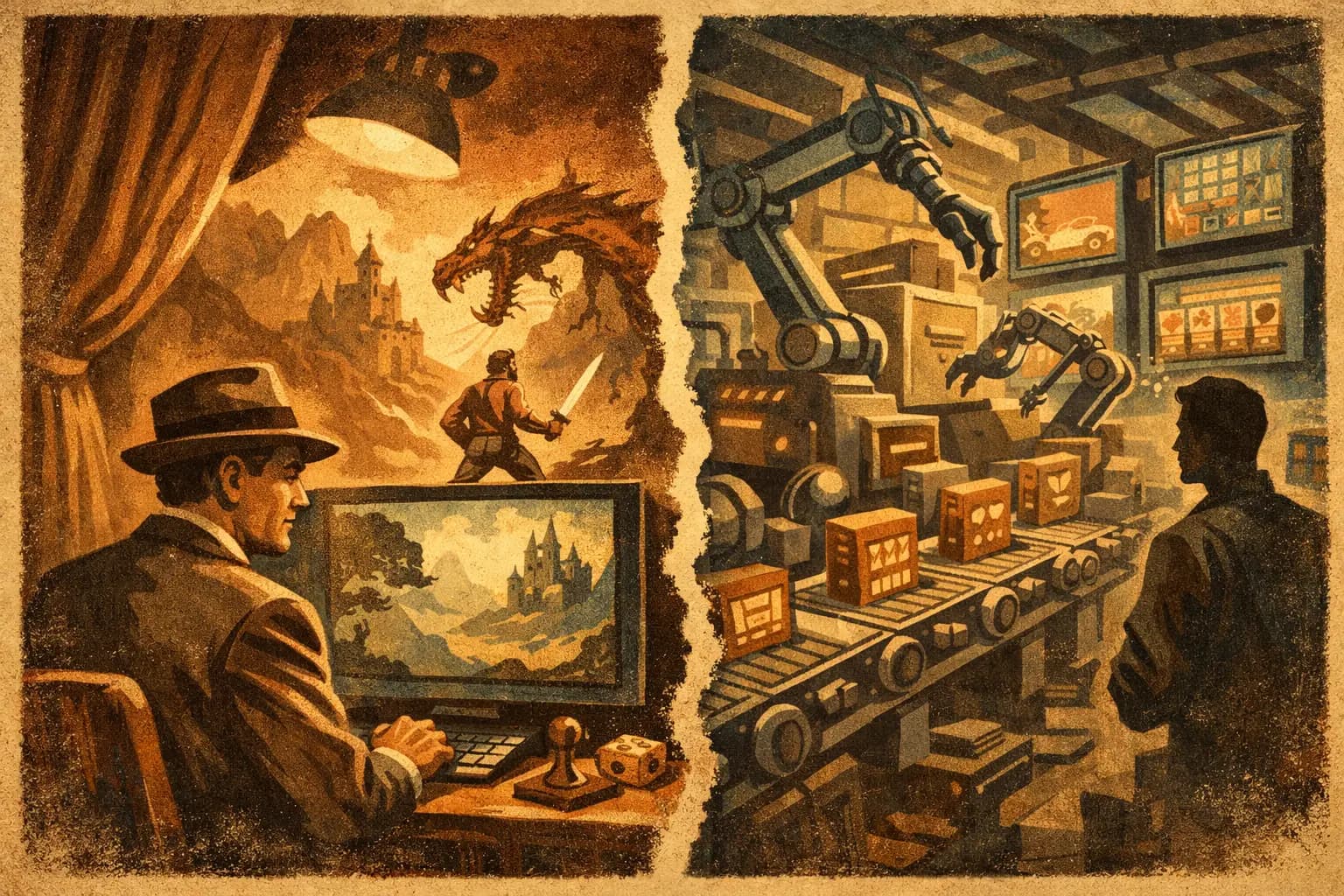
Most operators do not lose players because they lack games. They lose them because their lobby looks interchangeable.
That is the real issue behind exclusive games vs aggregator content. On paper, aggregator catalogs solve a content gap fast. In practice, they often create the same front end, the same release cadence, and the same dependency stack across competing brands. If your acquisition costs are rising and your retention curve depends on content performance, sameness gets expensive.
Exclusive games vs aggregator content is really a control question
This comparison is not just about how many titles you can launch. It is about who controls the product, the timeline, the economics, and the player experience.
Aggregator content is useful because it gives operators immediate volume. You can fill a lobby, satisfy category expectations, and reduce the burden on your internal product team. For a startup casino or a market entry brand, that matters. Speed to breadth is a legitimate commercial advantage.
But breadth is not differentiation. If the same games sit across ten competitor sites with near-identical promos, your content stops being a lever. It becomes table stakes.
Exclusive games work differently. They are built for one operator, one roadmap, and one positioning strategy. That changes the economics of the game itself. You are no longer trying to outperform competitors with the same assets. You are creating something they cannot run.
That has direct implications for retention, branded campaigns, VIP segmentation, affiliate angles, and cross-sell performance. It also changes how product teams think about roadmap planning. A proprietary title is not just another game drop. It is an owned commercial asset.
What aggregators do well and where they start to drag
There is no point pretending aggregators do not solve real problems. They do. They reduce procurement friction, give access to established studios, and let operators stand up a credible content offering without waiting six months for bespoke production. For many platforms, especially early-stage ones, that is the right move.
The trade-off starts once scale matters.
An aggregator model usually means shared supply, standardized integrations, fixed commercial terms, and limited product influence. You get what is available. You can promote it, merchandise it, and organize it better than the next operator, but you do not own the core asset. If a title performs well, it performs for everyone else too.
That creates a ceiling. The more successful your operation becomes, the more expensive commodity content feels. Not always in invoice terms, but in strategic terms. You are spending acquisition money to send players into a catalog they can find elsewhere.
There are also operational trade-offs. Aggregator stacks can introduce delays in release management, fragmented support paths, and less flexibility around game logic, bonus behavior, or localization depth. None of that matters much when all you need is more supply. It matters a lot when product velocity and margin discipline become board-level concerns.
Why exclusive content changes operator economics
Exclusive content is not valuable because it sounds premium. It is valuable because it can alter player behavior in ways shared content cannot.
A proprietary slot or fast game gives the operator something rarer than volume - relevance. You can design around your actual audience, not a generic studio assumption about the market. High-volatility profiles, feature pacing, session length, branded themes, event alignment, bonus hooks, and retention mechanics can all be shaped around your traffic mix and commercial goals.
That matters if your user base is not generic, which it rarely is. A crypto-heavy offshore audience behaves differently from a regulated casino segment in a mature market. A sportsbook-first cross-sell audience reacts differently from a slots-native VIP cohort. Shared content tends to flatten those differences. Exclusive content can use them.
There is also the issue of ownership. When the source code, math documentation, and certification package are transferred to the operator, the game stops being rented differentiation. It becomes infrastructure. That reduces long-term dependency and gives product teams more control over future updates, compliance handling, and platform-level planning.
For serious operators, that is not a small point. Supplier risk is real. If your roadmap depends entirely on third-party pipelines, your content strategy is only as strong as someone else's queue.
The retention argument is stronger than the acquisition argument
Operators often approach exclusive content as a marketing play. That is only half the story.
Yes, exclusives can support acquisition. They give affiliates a clearer angle, improve campaign differentiation, and create launch moments that are actually specific to your brand. But the bigger upside is usually retention.
When a player knows a title is only available on one platform, there is a practical reason to return. If the game is tuned well and merchandised correctly, it can become part of the brand's repeat-play identity rather than just another tile in a crowded lobby.
This is especially true for branded fast games and custom mechanics-led releases. Slots can carry exclusivity well, but crash, mines, dice, limbo, and wheel products often create stronger habitual behavior when they are built tightly around the operator's UX and wallet flow. Those games live or die on pacing, animation timing, bet flow, and session rhythm. Shared supply rarely nails those details for one operator because it is not trying to.
Exclusive development gives product teams room to shape those details deliberately.
Where exclusive development can go wrong
Exclusive is not automatically better. Bad custom content is still bad content, just more expensive and less forgiving.
If the studio is slow, overstaffed, or process-heavy, the benefits of exclusivity get buried under missed deadlines and bloated scoping. If the commercial model forces a large upfront build fee, the operator takes more risk before there is any performance data. And if the supplier cannot handle certification, math documentation, or production-grade integration standards, the project becomes a roadmap distraction.
That is why the real comparison in exclusive games vs aggregator content is not simply custom versus shared. It is execution-ready exclusivity versus commodity convenience.
A lean, senior-led production model changes that equation. If the game is built fast, integrated cleanly, and delivered with the technical package needed for regulated or offshore deployment, then exclusive content stops being a luxury project. It becomes a commercially rational one.
How operators should make the call
The right answer depends on your stage, your content mix, and what problem you are trying to solve.
If your lobby is thin, your market entry is new, or your team needs immediate scale, aggregator content is still useful. It buys time. It gives your casino the minimum viable depth expected by players. It can absolutely be part of a smart launch strategy.
If your brand already has traffic, if your CRM team can support proprietary launches, and if your product team is tired of competing with the same catalog everyone else has, exclusive content starts making more sense. That is especially true if you have clear player segments, a strong promotional engine, or a roadmap that depends on being less replaceable.
In reality, most mature operators need both. Aggregators provide breadth. Exclusives create edge.
The mistake is treating those two content types as equal strategic assets. They are not. One fills shelves. The other gives the shelf a reason to exist.
For that reason, the best operators usually do not ask whether they should abandon aggregators. They ask which parts of their content strategy are too important to share. That is the better question. It forces a decision around ownership, margin, retention, and speed instead of defaulting to convenience.
A company like Slot Studio sits in that exact gap - between operators who want proprietary content and the slow, expensive studio models that make custom production feel harder than it should be. That matters because exclusivity only works when execution does.
The smarter content mix is not bigger. It is more defensible.
Operators do not build strong brands by adding more of what every other brand already has. They build them by deciding where sameness is acceptable and where it is costly.
Aggregator content has a place. It is fast, familiar, and operationally convenient. But convenience has a shelf life. Once your brand needs stronger retention, better margin logic, and content that supports your own roadmap instead of someone else's, shared supply starts to look less like scale and more like drift.
The operators who win this cycle will not be the ones with the biggest lobby. They will be the ones with the clearest answer when a player asks, why stay here instead of anywhere else?